
Lawndale's Historical City Directory Shelf
Lawndale appears in a set of Los Angeles-area city and street-address directories, not necessarily in a book titled only for the city. The most useful starting point is the Los Angeles Public Library's digitized regional run. Its scope reaches selected volumes from 1875-1987 and supports name and address searching. Central Library adds Los Angeles directories from 1873-1942, paper holdings, and a large microfilm collection. The table separates the main directory collections from companion sources that help explain an entry.
| Collection | Years | Where Held | Access |
|---|---|---|---|
| Los Angeles-area city and street-address directories | 1875-1987, selected volumes | LAPL Visual Collections | Free digital name and address search |
| Los Angeles city directories | 1873-1942 | LAPL Central Library, paper and microfilm | On-site; selected digital volumes |
| U.S. city-directory microfilm | 1861-1960 | LAPL Central Library, 5,000+ rolls | On-site research |
| Los Angeles County Californiana | 19th-20th century | Norwalk Library closed stacks | Call ahead and request assistance |
| Historic California voter registers | 1900-1968 | Ancestry Library Edition at a library | Library access; address searches |
The LAPL digitized city and street collection gives Lawndale researchers a direct name and address search across selected regional volumes.
The digital shelf is broad, but each volume still needs a title-page and scope check before a South Bay entry is treated as local.
The Central Library reports about 1,000 U.S. hard-copy directories alongside more than 5,000 microfilm rolls. Those numbers describe a broad research collection, not a promise that every Lawndale year is present. Regional coverage also changes by publisher. A suburban section may be filed under a South Bay heading, while a Los Angeles city volume may omit the community entirely. Check the catalog record, volume title, publisher, and geographic scope before searching page by page.
Lawndale City Directory Index
The LAPL Directory Index is the quickest way to test whether a Lawndale collection is worth a trip or a longer digital search. It is a holding index, not a resident roll. Use the community field for Lawndale and nearby forms, then widen the county or region when the first search is too narrow. The operator controls matter because the index can search several fields at once.
Open the LAPL Directory Index to compare its field layout before choosing a year or publisher.
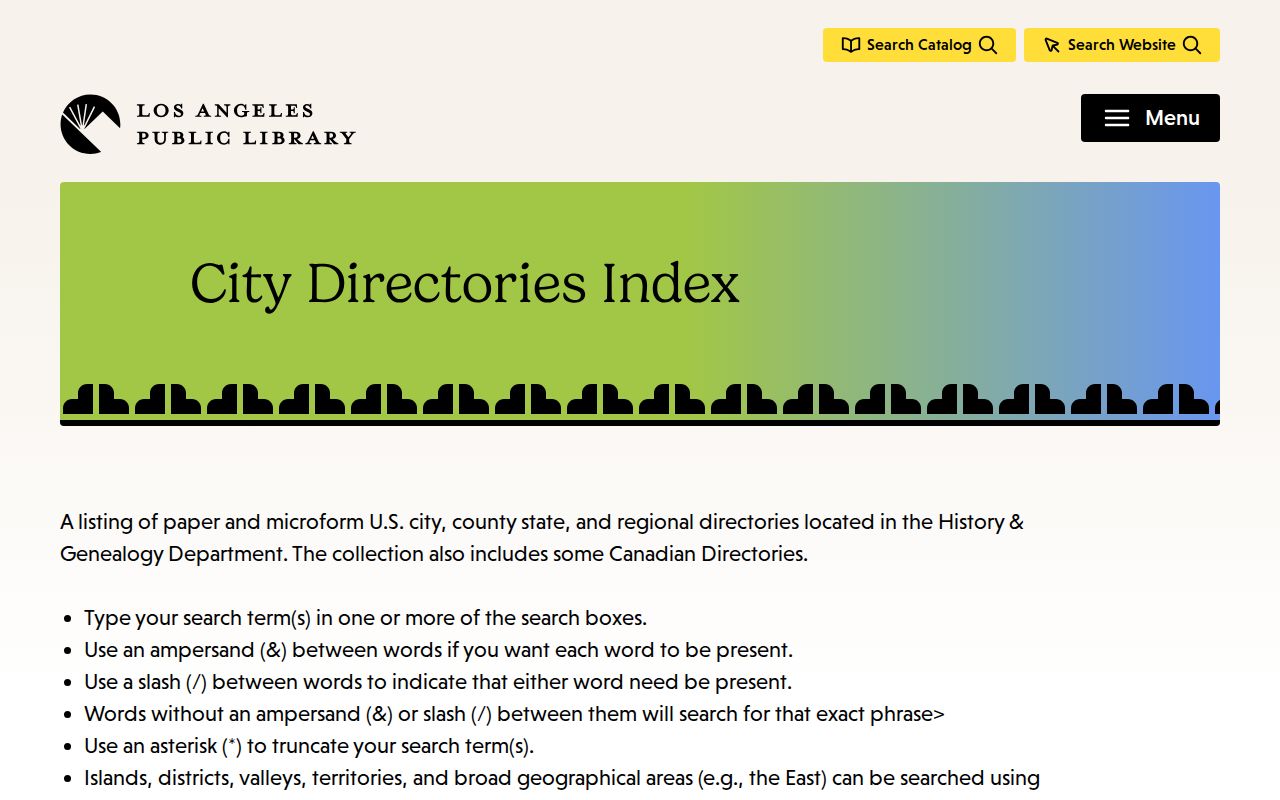
The index view helps distinguish a Lawndale reference from a Los Angeles-only title, which is the key regional search problem.
| Keyword | Text field with an operator; searches all indexed fields. Ampersand means AND, slash means OR, and an asterisk truncates. |
|---|---|
| City or Community | Text field with an operator; try Lawndale and the community form used by the catalog. |
| County | Text field with an operator; Los Angeles narrows a broad U.S. directory shelf. |
| State or Province | Text field with an operator; California is indexed with the two-letter form CA. |
| Region | Text field for a South Bay or broader regional search. |
| Search | Returns holding records, publisher, year, and format details. |
Search Lawndale first, then repeat with Inglewood, Hawthorne, Gardena, and Redondo Beach or South Bay when the volume title suggests a regional section. That sequence does not prove that a person lived in each place. It only follows the catalog's geographic language and reduces the risk of overlooking a suburban page filed outside the Lawndale name.
Lawndale Central City Directory Shelf
LAPL Central Library's History and Genealogy holdings give a Lawndale researcher a second route when OCR is poor or a volume is not digitized. The Los Angeles directory run from 1873-1942 is held in paper and microfilm, while the wider microfilm shelf covers U.S. cities from 1861-1960. Library staff can help locate the right format, but the catalog record still controls whether a particular community or year is included.
Review LAPL's genealogy holdings for the directory, census, Sanborn, newspaper, and database layers available through the research collection.
The genealogy collection places city directories beside other records, making it easier to test an address clue against a household or a death notice.
Lawndale Library is the practical local starting point. The branch at 14615 Burin Ave. can be reached at 310-676-0177. Posted hours are Tuesday and Wednesday noon-8 p.m., Thursday through Saturday 10 a.m.-6 p.m., and closed Sunday and Monday. Telephone and in-person research help, public computers, Daily Breeze and Los Angeles Times access, and library databases make the branch useful even when the specialized shelf is downtown or in Norwalk.
- Check the LAPL catalog record for the year, community, format, and holding location.
- Use Lawndale Library for local newspaper access and staff help with a South Bay clue.
- Call Norwalk before requesting a closed-stack Californiana item.
- At Central Library, photograph the title, scope, and abbreviation pages before copying entries.
Reading Entries in a Lawndale City Directory
A Lawndale city directory entry is a publisher's snapshot. The alphabetical section usually begins with a surname, given name or initial, and sometimes a spouse in parentheses. It may add an occupation, employer or work address, followed by a home address. These details help distinguish two people with the same name, but they are not a certificate of identity or a complete household count.
| Surname and given name | Read the spelling, initials, spacing, and any second surname exactly as printed. |
|---|---|
| Spouse | A spouse may appear in parentheses or in a separate line, depending on the publisher. |
| Occupation or work address | A historical clue that can separate people with the same name. |
| Home address | Use the street number and street name for a reverse search and neighborhood comparison. |
| Publisher abbreviations | Read the volume key before interpreting h, r, bds, or wid. |
- Criss-cross directory
- A street-order section that reverses the usual name-first arrangement and groups entries by address.
- Householder index
- A name or address aid that points to the head of a listed household; it does not enumerate every occupant.
- Abbreviation key
- The publisher's explanation of short marks. In Lawndale research, h commonly means house or home, r means residence or rooms, bds means boards, and wid marks a widow followed by a deceased spouse's name.
- OCR
- Optical character recognition turns a scanned page into searchable text, but names, initials, and street numbers still need image review.
The documented 1893 Tessa Kelso example shows why each field matters. The entry supplies personal status, occupation, a home at 455 S. Broadway, and the building name The Acacia. An address search then finds seven other occupants, including Adelaide R. Hasse. The 1894 entry changes Kelso's address. That move is a strong lead for a family-history timeline, but it still needs a census, newspaper, or other record for confirmation.
The LAPL sample directory record shows the catalog's entry-level context before a researcher reads a name or address as local evidence.
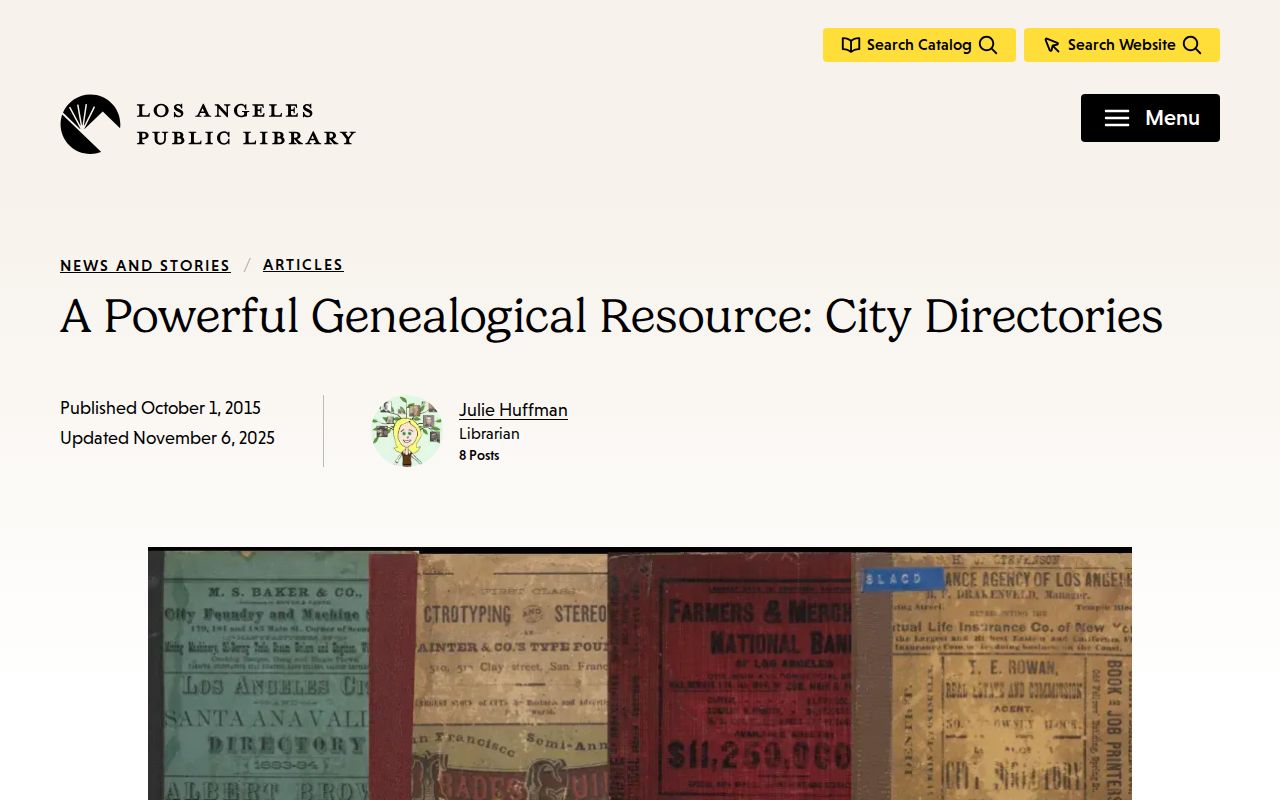
The sample view reinforces the need to read the publisher's abbreviations and geographic scope before comparing years.
Reverse Lawndale City Directories
Reverse searching turns a street address into a list of listed names. In a formal criss-cross section, start with the street heading, find the number, and record the occupant or telephone entry. In a digitized book without a formal reverse half, put the quoted address into OCR search and inspect the page image. Search spelling variants because OCR often drops periods, turns a number into a letter, or breaks a compound surname.
Street-order research is especially useful when a known address has no obvious name. It can reveal a neighbor, a spouse, or a second entry at the same number. Lawndale's compact 1.97-square-mile footprint makes a block comparison practical, but its detached and duplex or two-unit forms mean one street number can hold multiple households. Capture the unit or apartment clue when the volume gives one.
Use the year and volume scope as a boundary. A regional city directory may place Lawndale under a South Bay section, while a nearby title may list Inglewood or Hawthorne separately. A missing name can mean a move, a missed canvass, a spelling change, or a coverage gap. It cannot by itself prove that a person was absent from the neighborhood.
Tracing Lawndale Families Through Directory Years
The most reliable household trail combines annual or near-annual directory entries with the public census years 1910, 1920, 1930, 1940, and 1950. The 1890 federal population schedules were largely destroyed nationally, so directories carry more weight for the years around that gap. Use the name list to find a person, the address section to find neighbors, and a census to test household relationships.
- Start with a known name, year, or normalized historic address. Search the surname and a quoted address.
- Read the title, date, publisher, canvass note, and abbreviation key before copying an entry.
- Record spouse, occupation, exact address, and any move or removal notation.
- Compare adjacent years to bracket arrival or departure, then pair 1910-1950 census schedules with the closest directory dates.
- Use newspapers, probate, deeds, and historic voter registers to decide whether a disappearance reflects a move, death, or an unlisted household.
Historic California voter registers from 1900-1968 are available through Ancestry Library Edition at a participating library. Search an address in quotation marks, then compare the name, registration place, and year with a city directory. Voter registers add a civic record, not a full list of residents. A directory entry adds an occupant clue, not proof that every household member voted or lived there throughout the year.
Lawndale Library's 1913 Address
Lawndale's library history supplies a useful address bridge. The first local library opened on December 26, 1913 at Railroad Avenue and Market Street. Those names are now Hawthorne Boulevard and 147th Street. A directory, map, or newspaper that uses the older pair may look disconnected from modern Lawndale until the street-name change is recognized.
The present 17,360-square-foot branch opened on March 18, 2009, after 52 years in an adjacent 3,500-square-foot building. Those dates are not merely civic trivia. They help place photographs, local notices, library mentions, and neighborhood references in the right address era. Search both old and current street names when a directory entry points near the library or City Hall cluster on Burin Avenue.
- 1875-1987: selected Los Angeles-area city and street-address directories form the regional digital run.
- 1913: the first Lawndale library opened at Railroad Avenue and Market Street, now Hawthorne Boulevard and 147th Street.
- 1959: Lawndale incorporated, shifting later local-government evidence toward City Hall while older records remain county and regional.
- 2009: the present Lawndale Library branch opened after decades in the adjacent smaller building.
For older material, LA County Library's Californiana Collection in Norwalk is closed-stack. It holds more than 24,000 books, over 200 paper or microfilm periodical titles, California census schedules from 1850-1910, nineteenth-century city directories, and official city and county histories. Call ahead for access. The Lawndale Historical Society Museum is reported closed until further notice, and no dependable public holdings catalog was located, so the library route is the verified starting point.
Lawndale House History Beyond Its City Directories
Historical volumes become stronger when paired with the other shelves used in a Lawndale house history. Daily Breeze and the Los Angeles Times historical archive can explain a move, death notice, civic event, or sale. Digital Sanborn Maps can show a structure's footprint and use where a local sheet exists. The California county naturalization collection and federal Los Angeles naturalization index cards can add a name, birthplace, petition, volume, or page for an immigrant household.
Use LAPL's house-history research guide to connect deeds, directories, historic voters, newspapers, and maps in a sensible order.
The guide reinforces the central distinction: a deed identifies title, a directory identifies a listed occupant, and a census describes a household at an enumeration date.
Lawndale incorporated on December 28, 1959, so pre-incorporation material often sits in county, school, postal, directory, census, and newspaper records. When a city directory ends or a name vanishes, probate and obituary records may explain the next step. Naturalization, Sanborn, and local newspaper clues should be treated as supporting evidence and checked against the original custodian when an exact identity matters.