
Lawndale Resident Lookup Record Map
Start by naming the question, not by running every search. Ownership, residence, court activity, a family event, a license, and custody status are different record subjects. The following map keeps a Lawndale resident lookup tied to the right custodian and shows where an online result stops.
| Record | What It Confirms | Where | Access |
|---|---|---|---|
| Assessor parcel | Address, AIN, parcel facts, and owner information at the counter | Los Angeles County Assessor current roll | Web facts; owner data at counter or by data product |
| Recorded deed | Title parties, name variants, transfers, and legal description | Los Angeles County RR/CC since 1850 | Norwalk terminal or copy order; no public web index |
| Voter verification | Whether submitted identity and address factors match a registration | LA County current voter tool | Self-check with four required fields |
| Historic voter register | A person linked to an address in a past registration period | Ancestry Library Edition, 1900-1968 | Library database access |
| Superior Court | Litigant, case type, filing place, date, and public case trail | LA Superior Court, with defined electronic horizons | Paid party-name index; clerk files and images have limits |
| Vital record | Birth, death, marriage, or dissolution event and relationship clues | LA County, local registrars, or CDPH | Informational and authorized-copy rules apply |
| SOS or FBN filing | Entity name, agent, registrant, and filing address | California SOS and LA County Clerk | Official indexes; copies or local filings vary |
| Professional license | Credential number, status, and public discipline fields | California board lookup | Free official search |
| Unclaimed property | Name tied to a reported city or ZIP clue | California state search | Free, name-led search with optional filters |
The map also separates title owner, listed occupant, registered voter, court party, and license holder. One person may appear in several roles, while a household member may appear in none of them. In Lawndale, that distinction matters because the Assessor suppresses owner names online and a single street number can represent several units. A name plus city is a lead. It is not identity proof.
Prove the Right Lawndale Resident
Same-name errors are common in a compact city. Lawndale has 31,807 residents in the 2020 Census count and only 1.97 square miles, so a familiar surname can appear across close streets and multiple units. Search accents, hyphens, spaces, compound surnames, former names, and initials as printed. California's newer vital-record guidance allows defined diacritical marks, but older indexes may omit them.
Use at least two independent identifiers before connecting a record to a person. An address or AIN is useful, as are a middle initial, spouse, filing courthouse, date, business entity, or distinct license number. A directory entry can bridge a name to an address, but a deed speaks to title and a court file speaks to a case. Do not use the apparent match to infer facts that the record does not state.
- Preserve the exact name, spelling, accents, initials, and any former surname.
- Anchor the name to a known Lawndale address or AIN when a property record is relevant.
- Compare a second identifier, such as a middle name, spouse, entity, filing date, or birth detail.
- Check the custodian's coverage years and search rules before treating a nonmatch as meaningful.
- Order or inspect the original record when a decision depends on the result.
A custodian can explain search syntax and coverage by phone, but staff normally do not perform an open-ended identity investigation or disclose protected facts orally. The cleanest name check is a narrow, documented comparison between records that were created for different purposes.
Lawndale Property Facts Before a Lookup
The Los Angeles County Assessor Portal searches by AIN or address. Its parcel detail can show situs address, use, values, physical features, exemptions, legal description, parcel maps, recent-sale information, and other roll fields. Owner names are intentionally omitted online. The South District Assessor counter or a lawful county data product is the route for owner information.
That offline step changes how an address-led name search should be written. The online parcel page can establish that an address and AIN refer to the same parcel. It cannot establish that the owner lives there, that every occupant is related, or that the current mailing destination is the physical site. A tax-bill mailing address may differ from the situs address for a trust, a nonoccupant owner, or another lawful arrangement.
Los Angeles County Recorder guidance explains the next step: deeds are indexed by grantor, grantee, and recording year, not by street address. Translate the address into an AIN, legal description, and current owner name before searching the Norwalk public terminal. The resulting deed trail can confirm title history, but it still does not list every Lawndale resident.
Lawndale Court Search Coverage
Lawndale cases go through the Superior Court of California, County of Los Angeles. The civil, family, probate, and small-claims party-name index has distinct electronic horizons: Unlimited Civil, Probate, and Family Law reach 1983-present; Limited Civil reaches 1991-present; Small Claims reaches 1992-present. The index updates daily. Older matters move to the Archives and Records Center route.
The LA Court civil party-name index requires payment before the name result, even when no match exists. The search may be made as a guest or through an account. Guest name results remain retrievable for two hours. Purchased document images remain available for 30 days. Those time limits matter when a Lawndale resident lookup is being saved for later comparison.
| Last Name | Required surname field; try punctuation and spelling variants. |
|---|---|
| First Name | Optional narrowing field for a common surname. |
| Middle Name | Optional where the interface exposes it; useful for identity separation. |
| Search type | Choose Civil, Family, Probate party, or Criminal defendant search as available. |
| Date range | Optional year or date pair; keep it within the record horizon for the case type. |
| Case type or location | Optional civil, small claims, family, probate, or filing-location filter. |
| Guest, login, and search controls | Payment authorization precedes the paid party-name result. |
The captured LA Court party-name screen shows why case type and filing place deserve attention.
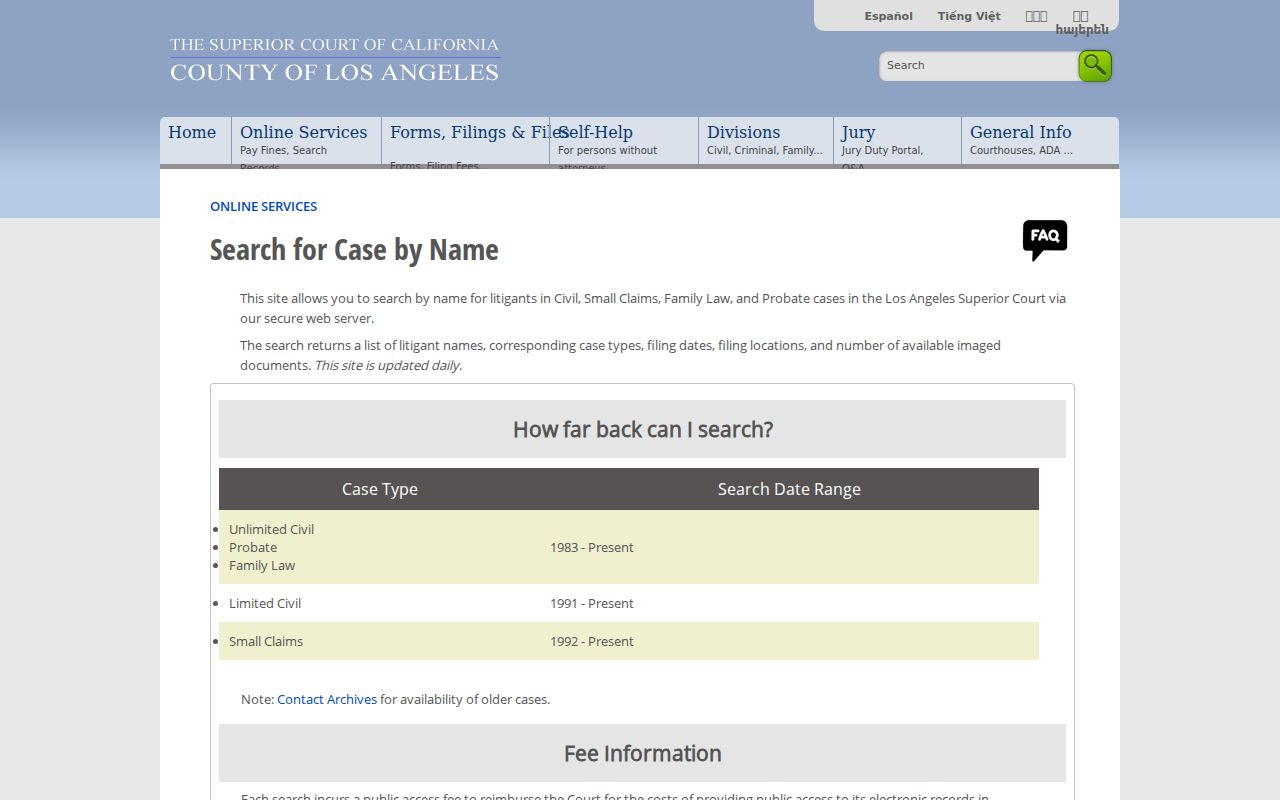
Use the result as an index lead, then request the file from the courthouse or archive that holds it.
Lawndale Resident Lookup Results
A paid party-name result is narrower than a case file. It returns the litigant name, case type, filing date, filing location, and count of available imaged documents. A known case number can produce a free case summary with the title or parties, filing courthouse and date, register-of-actions events, hearings, status, and public disposition details where available.
- Case number and filing courthouse, where the case-summary search accepts both.
- Litigant name, case type, filing date, and filing location from the name index.
- Register-of-actions events, scheduled hearings, status, and disposition when public.
- Available image count, with purchase limits that vary by record type.
- Sealed, confidential, juvenile, adoption, paternity, and certain minor-related matters withheld from ordinary results.
The court access and fee rules show why an image count is not the same as a complete file. Civil limited, civil unlimited, and small-claims images may be purchasable. Criminal and family-law images are not available online through the same route. Copies from the clerk have their own schedule, and archived files require a separate request.
The Court's case access routes separate party-name search, case-number access, calendars, and document images. Federal matters are different: PACER searches the national federal case and docket system, including the Central District of California. A state court nonmatch does not answer a federal search question.
Review the court access screen before paying for a result that may not contain the desired image.
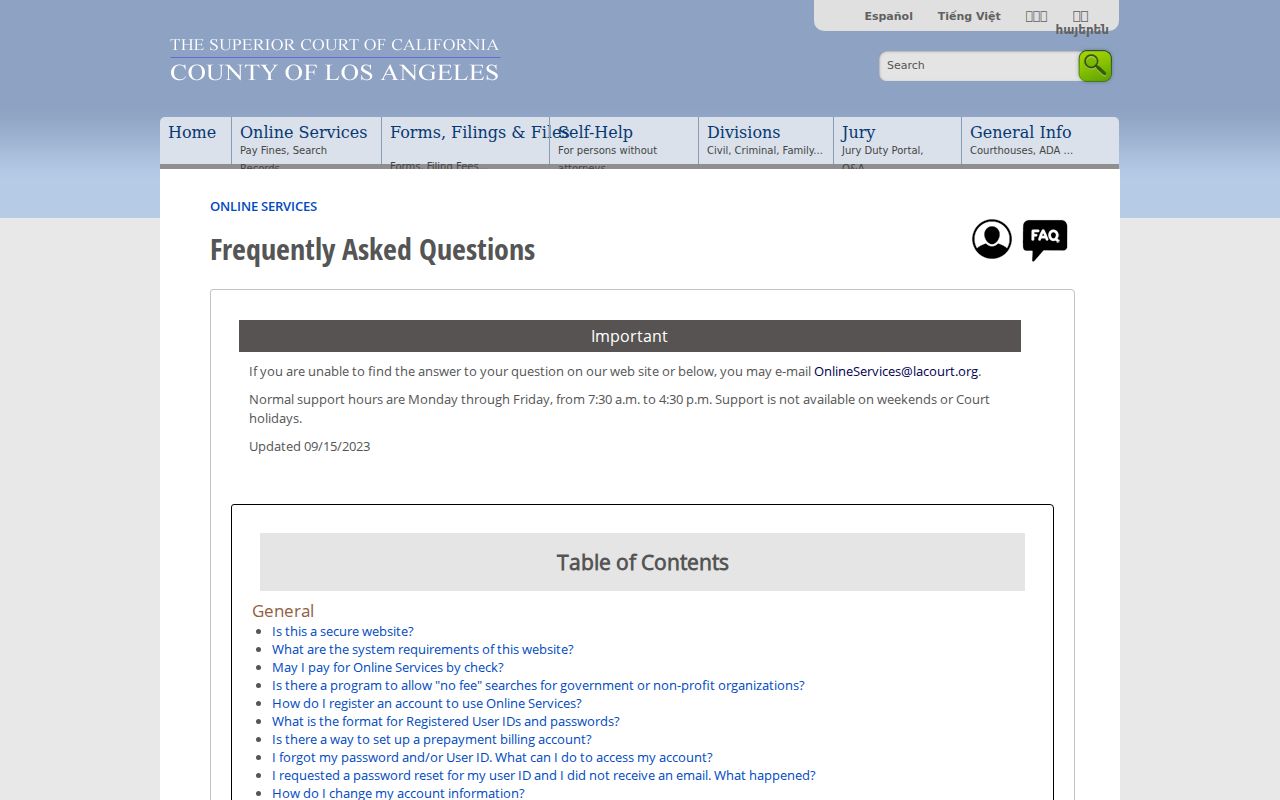
The two-hour guest window and 30-day image window make prompt downloads and source notes worthwhile.
- Docket
- The court's running record of filings, events, hearings, and status entries in a case.
- Index versus image
- An index points to a case or party; an image is a scanned document that may require payment or may be unavailable.
- Certified copy
- A copy issued or authenticated by the custodian, with a legal status different from an online index view.
Lawndale Voter Lookup Is Self-Only
LA County voter verification asks for four matching fields: last name, full birthdate, house number, and five-digit ZIP. The form is a person's self-check. It is designed to prevent browsing by a name or street and cannot enumerate everyone at a Lawndale address. A nonmatch may reflect changed registration, an input mismatch, protected status, inactivity, or no registration.
California Elections Code §2194 limits access to voter files to approved governmental, election, scholarly, journalistic, or political purposes. Sensitive identifiers remain confidential. An authorized requester can use the county's voter-information purchase route, which posts separate prices for a countywide file, a precinct, district, or city file, and an added file. The requester must state the permitted purpose and follow the use restrictions. That route is not a public resident browser.
The voter record may include name, residence or mailing address, registration date, party preference, status, precinct and district fields, and election participation history. Participation indicates whether a ballot was cast, not the selections on a secret ballot. Historical California voter registers from 1900-1968 are a separate library research source and can be searched by address in quotation marks.
The county file-request route is the proper reference for current fees, eligibility, and delivery details.
Lawndale Vital Records for a Lookup
California does not use one simple genealogy waiting period after which every vital record becomes open. The CDPH vital-records overview describes the state and local custodians. Informational copies of many nonconfidential certificates can be requested by the public, but an authorized certified copy is limited to statutory classes. Health and Safety Code §§103526 and 103526.5 govern the distinction. Confidential marriage records are different under Family Code §511 and are available only to spouses or by court order.
| Record | Lawndale custodian route | Public path | 2026 CDPH fee |
|---|---|---|---|
| Birth | LA County RR/CC, local registrar, or CDPH | Informational copy; authorized classes for certified copy | $31 |
| Death | LA County RR/CC, local registrar, or CDPH | Informational copy; authorized classes for certified copy | $26 |
| Public marriage | Recorder or CDPH statewide route | Public informational copy; authorized rules for certified copy | $19 |
| Dissolution | Superior Court decree or CDPH certificate route | Case and certificate access differ | $18 |
CDPH birth records reach back to July 1905. The VS 111 birth request records the registrant's full name at birth, birth date and city or county, sex, parents' full names including birth surnames, number of copies, requester information, relationship, purpose, signature, and the choice between authorized and informational copy. An authorized mail request includes the notarized sworn statement, commonly the VS 20 component. The CDPH custodian guide explains how local registrars, recorders, clerks, and the state divide the work, while the LA County Clerk records route covers county services.
The CDPH birth application route requires the completed VS 111, the sworn statement when needed, and a check or money order for $31 per copy. No cash is sent. Mail goes to CDPH Vital Records, MS 5103, P.O. Box 997410, Sacramento, CA 95899-7410. A search fee can be retained when no certificate is found under Health and Safety Code §103650.
Check the current 2026 CDPH fee schedule before ordering. Informational copies can establish a historical lead, but they do not establish identity in the same way as an authorized certified copy.
Lawndale Heir and Classmate Lookup Trails
A resident lookup often starts with a personal history question. Probate is a lawful route for an heir question when a deed or address trail ends. A petition, notice, or final distribution may name heirs or interested persons, subject to redaction and court access rules. Adoption searches are different. Birth-parent or adoptee information follows California Department of Social Services consent routes or a court procedure, not an ordinary public-record request.
- Use Lawndale, Leuzinger, and Lloyde High School yearbooks, alumni material, library databases, and newspapers for a former classmate.
- Join an old address to an obituary, probate file, or official death record before inferring a family relationship.
- Compare California SOS entity records, a Los Angeles County fictitious business name filing, a Lawndale license record, and a DCA or ABC record for a business trail.
- Use the California Unclaimed Property name search as a clue when a former address or city is known.
- Ask the original custodian to correct a parcel, court, voter, vital, or license error; a private compilation cannot amend the source.
California SOS bizfile can show an entity's legal name, number, status, jurisdiction, addresses, agent, and filing history. A California DCA license search adds credential status and public discipline fields where the board publishes them. An agent-for-service address or business filing does not prove a person's residence. Keep the business record in its own category.
School records and yearbooks can be especially helpful for a classmate because they preserve a year and a community context that a current address source may not. Use a nonintrusive public contact route when reconnecting. A result that exposes a name does not create permission to pursue a person.
Lawful Limits on a Lawndale Resident Lookup
California privacy rules shape what a Lawndale resident lookup can return. Safe at Home gives eligible survivors and specified protected groups a substitute mailing address and mail forwarding. It interfaces with voter and government records, but it does not automatically erase older public documents. Voter information is also restricted by Elections Code §2194, and DMV personal information is protected by the federal Driver's Privacy Protection Act.
California's 2026 DROP service lets a resident submit one deletion request to participating data brokers. It opened January 1, 2026. Mandatory broker processing began August 1, 2026, at least every 45 days. A deletion from a broker does not erase a deed, court file, or other government record that lawfully remains with its custodian. Keep confirmation numbers and avoid sending more identity material than the request requires.
The Los Angeles County Sheriff Inmate Information Center is a separate local-custody route. CDCR CIRIS searches current or former state custody by name or CDCR number, subject to exclusions and update limits. California Megan's Law provides name, map, and address-area modes with statutory exclusions and explicit misuse warnings. Neither source should be used to threaten, follow, or expose a protected person.
The California Megan's Law search illustrates why a public registry result still needs a lawful purpose.
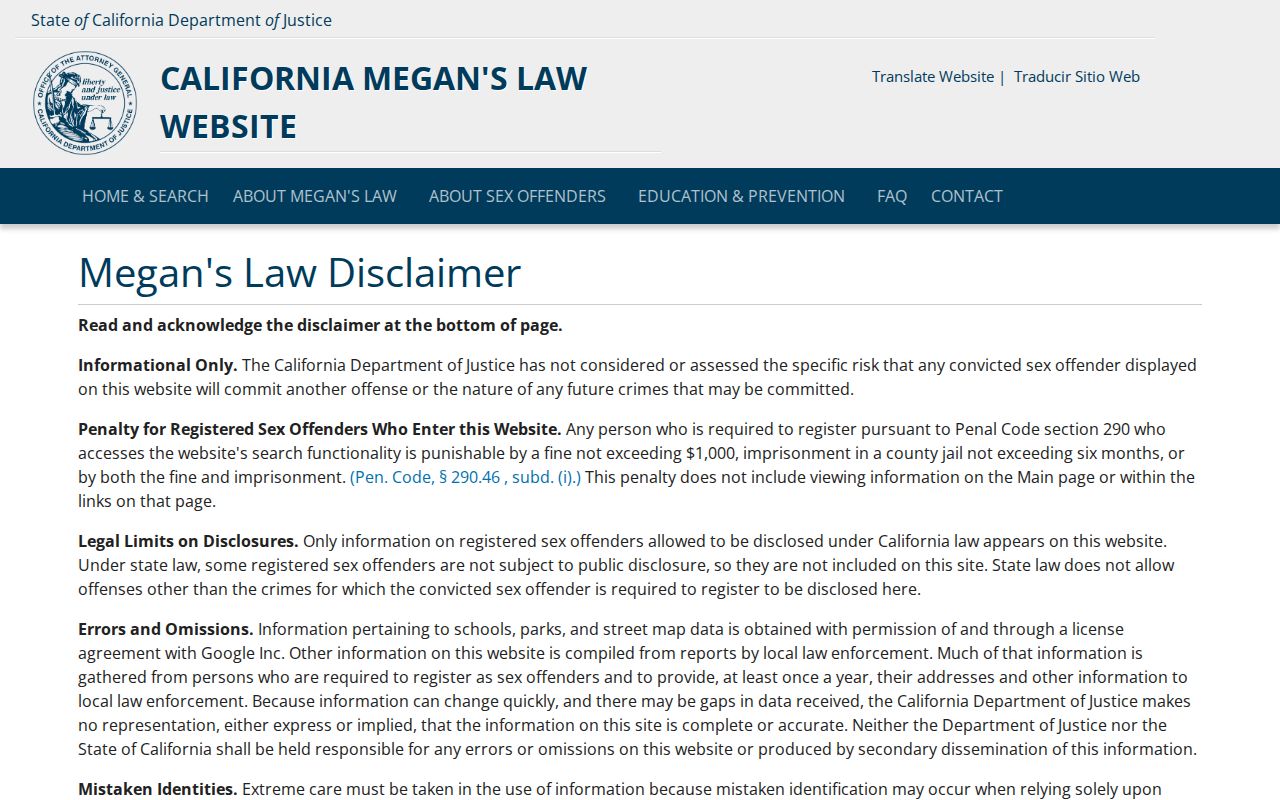
Registry information has accuracy and location limits, so verify any material fact with the responsible custodian.
California Safe at Home information explains the substitute-address protection and its limits.
The CDCR CIRIS search is a custody lookup by name or CDCR number, not a general address directory.
The CDCR search is a custody record, not a general address or resident directory.
Lawful use. A Lawndale resident lookup is for personal, lawful research. California stalking, criminal-threat, harassment, identity-theft, voter-file, and DMV privacy rules can apply when records are used to track, intimidate, impersonate, or harm another person.