
How Lawndale Residents Come Into Focus
A Lawndale residents directory search works best as a short chain, not as a hunt for one perfect list. The property roll describes a parcel. A deed names parties to a transfer. A voter tool checks a person’s own registration. A city permit can add an applicant, contractor, date, or work description. A court index can show that a person with a matching name appeared in a case. Historical directories and census schedules add household context that a current roll does not provide.
Keep the question narrow. A name search needs spelling variants, a middle initial, an old address, a spouse, a business, or an approximate year. An address search needs a standardized situs, an Assessor Identification Number, and a check of the city boundary. Ownership is not the same as residence, a directory entry is not a complete household count, and a voter match is not a public list of everyone at the house.
- Start with the Lawndale address or exact name you can defend, then preserve accents, two surnames, hyphens, initials, and former names.
- Use the Los Angeles County Assessor Portal or map to capture the parcel facts and AIN. Owner data is not shown on the ordinary web page.
- Move to the RR/CC counter or a lawful data channel for a current owner, then search the deed index by grantor, grantee, and year.
- Use the LA County voter verification form only for a voter’s own four-field check, and use libraries for historic voters and directories.
- Ask the City Clerk or the correct county or state custodian for an existing record when no online index answers the question.
Lawndale Offices Behind Resident Records
Lawndale is an incorporated South Bay city, but the durable records behind a Lawndale residents directory sit mostly with Los Angeles County or California. City Hall is the first stop for permits, code files, minutes, licenses, and a California Public Records Act request. The RR/CC handles deeds, marriage services, county birth and death copies, fictitious business names, and voter services. The Assessor supplies parcel facts. Each office answers a different part of the resident question.
Norwalk is the county records hub. The Recorder Division keeps Los Angeles County real-estate records from 1850, while the Superior Court keeps case indexes and files. The library layer matters just as much for past households. Lawndale Library offers local help and newspapers, and Los Angeles Public Library holds the regional directory and genealogy shelves.
Los Angeles County RR/CC
12400 Imperial Highway
Norwalk, CA 90650
800-201-8999
Los Angeles County Assessor
Parcel facts and maps
Lawndale AIN and situs search
Owner data at office counter
Lawndale Parcel Search Starts With an AIN
The Los Angeles County Assessor Portal is the cleanest first step from a Lawndale street address to a parcel. Search by AIN or address, then save the situs address, use type, parcel status, tax-rate area, units, values, year built, legal description, map links, exemption indicator, and recent-sale details. The portal can show rich property facts while withholding the owner name online. That split is deliberate, not a failed search.
Use the Assessor Property Assessment Information System map to view parcel outlines and neighboring lots. A map click can supply another AIN, but it does not turn a parcel into a household roster. Owner information is available through the Assessor counter or a purchased data product described by the county. Record the inspection date because parcel display, detail pages, and the 24-month sales layer run on different update cycles.
| Assessor control | Type | Use in a Lawndale search |
|---|---|---|
| Search by AIN or Address | Autocomplete or text | Enter a hyphenated AIN or full situs address. |
| Basic Search | Tab or button | Opens the AIN and address route. |
| Legal Search | Tab or button | Works from legal-description information. |
| Map Search | Link or button | Opens parcel geometry and adjacent-lot browsing. |
- AIN
- The Assessor Identification Number, a parcel locator rather than a count of people.
- Situs
- The physical address of the parcel, which may differ from the owner’s mailing address.
- Legal description
- The recorded lot, block, tract, or other land description that survives a street-name change.
- Parcel roll
- The county’s assessment record for land, improvements, values, use, and related status fields.
Lawndale Deeds: Not an Online Address Search
Los Angeles County real-estate documents date from 1850, but the official grantor-grantee database is not publicly searchable online by street address. The RR/CC index uses grantor, grantee, and recording year. A grantor is the party giving an interest, often a seller. A grantee receives it, often a buyer. The index is a name-and-year bridge, not a map.
Once a current owner and legal description are obtained through a lawful Assessor channel, search the current purchase deed at a public terminal in Norwalk. Note the document number, recording date, type, and legal description. Then use the seller as an earlier grantee and repeat. Older records may require books, film, or a copy request. Online ordering, mail, fax, and in-person requests are available through the RR/CC real-estate copy route, which says orders are processed within 20 working days.
Note: A deed can establish a recorded transfer while leaving the occupants, unit count, and day-to-day household outside the deed record.
Lawndale Permits Add Dates to Addresses
The Lawndale Permit Center adds an address-centered layer to the Lawndale residents directory. The city archive may expose an applicant, owner, contractor, permit type, issue or final date, work description, and status. Those fields can show when a structure changed or when a named person interacted with a property. They do not prove continuous residence, and older files may need a CPRA request or offsite retrieval.
Community Development, Building and Safety, Planning, Code Enforcement, Public Works, and Finance share the city contact map. Digital applications go to cdd@lawndale.ca.gov with the project address in the subject line. The city describes PDF plans and documents, JPEG or PNG photos, a 25 MB email limit, and an expected 1 to 2 business-day reply excluding closures. The Permit Center posts Monday through Thursday, 7 a.m. to 6 p.m. hours.
For an address chronology, start with the Lawndale Permit Center archive workflow. If the result is thin, use the city’s submission instructions or request a specific date span, record type, case number, final notice, or closed-case file. Complainant identities and investigative material may be withheld.
Lawndale’s city forms entry point gives the city-side context for address research and the public-records route shown below.
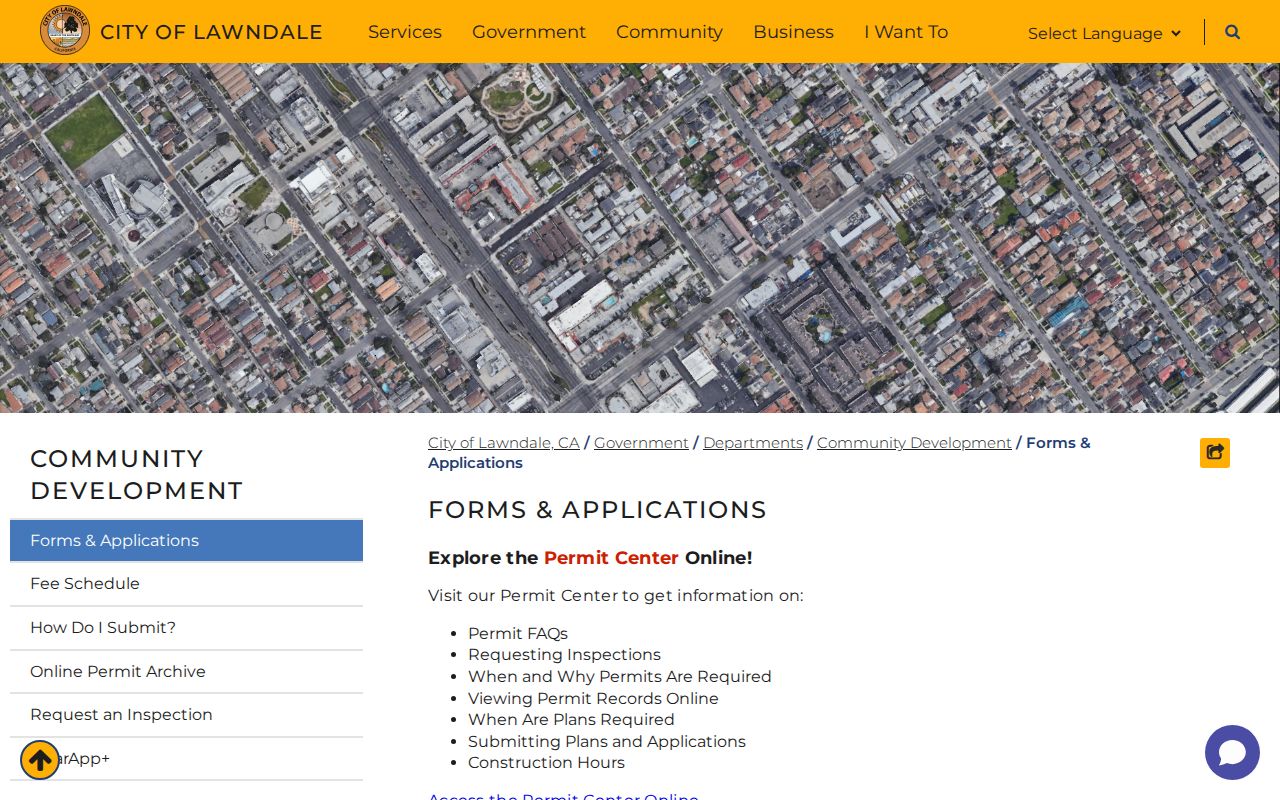
The capture pairs a city address with the forms and record routes that may supply the next document when the permit archive does not show an older file.
Today’s Lawndale Resident Directory Sources
No single current Lawndale residents directory lists every person. The source table below keeps roles separate. Property records describe owners and parcels. Voter verification confirms a person’s own supplied details. Deeds show parties to recorded instruments. Permits show people tied to a project. Business and license registers show a public professional or entity connection. None should be treated as a complete census.
| Source | What it can show | Keeper | Access |
|---|---|---|---|
| Assessor Portal | AIN, situs, use, values, units, legal description | LA County Assessor | Free web facts; owner omitted |
| Voter verification | Match for a voter’s name, birthdate, house number, and ZIP | LA County Elections | Free self-check; restricted file rules |
| Recorder index | Grantors, grantees, documents, dates, and legal descriptions | LA County RR/CC | Terminal or copy order |
| Lawndale permit archive | Applicant, contractor, work, address, and dates where exposed | Lawndale Community Development | Online archive; CPRA fallback |
| State license or entity index | Public credential, entity, agent, status, or business address | California agencies | Free official searches |
The right source depends on the claim. For one person, combine at least two independent identifiers before treating a match as useful. For a property, keep the AIN and legal description with the street address. For a historic household, add a directory, census, voter, obituary, or probate source. The focused Lawndale resident lookup uses that identity-first sequence.
Lawndale Voter Verification Is a Self-Check
The LA County voter form is often mistaken for a public Lawndale resident directory. It is not. The form asks for last name, full birthdate, house number, and five-digit ZIP, then checks whether those supplied details match a registration. A nonmatch can reflect a changed record, a spelling or input mismatch, an inactive registration, a protected address, or no registration.
California Elections Code section 2194 limits voter-file access to approved governmental, election, scholarly, journalistic, or political purposes. A county purchase route posts different file and fee options, but a requester must state an authorized purpose. Sensitive identifiers and signatures remain confidential. Historical California voter registers from 1900 through 1968 are a separate library research resource, especially when an address is searched in quotation marks.
Use the LA County voter verification form for the voter who supplied the information. It can confirm a narrow match. It cannot enumerate the people in a Lawndale building, reveal ballot choices, or replace the deed, assessor, directory, and census trail.
Los Angeles Court Names for Lawndale Research
Lawndale has no separate city court. Los Angeles Superior Court handles civil, criminal, family, probate, and small-claims matters. Its paid civil, family, probate, and small-claims party-name index covers unlimited civil, probate, and family matters from 1983 forward, limited civil from 1991, and small claims from 1992. Older files move to the Archives and Records Center workflow.
A paid search returns a litigant name, case type, filing date, filing location, and count of available imaged documents. The fee is charged before results even when no match appears. Guest name results remain retrievable for two hours, and purchased images for 30 days. A known case number uses a separate case-summary path. Sealed, confidential, juvenile, adoption, paternity, and some family materials are not ordinary public search results.
For a Lawndale name trail, begin with the LA Court party-name index only when the case type and date range fit. Federal matters need a separate federal docket search for the Central District of California. A court hit is a case connection, not proof that every same-name person is the litigant.
Earlier Lawndale Households in Print
Historical Lawndale residents directory work is regional. LAPL’s selected digitized Los Angeles-area city and street-address directories span 1875 through 1987, while the Central Library holds Los Angeles city directories from 1873 through 1942 in paper and microfilm. Lawndale may appear in a South Bay, suburban, or neighboring community section rather than in a volume titled Lawndale. Search the Directory Index before assuming a year is absent.
A reverse or criss-cross directory turns the usual name list around. A researcher locates a street and number, captures the listed occupant or telephone entry, and then returns to the alphabetical section for an occupation, spouse, or work address. The entries are publisher observations, not proof of title or a complete household. The Lawndale city directory collections page follows the shelf, entry fields, and year-by-year method in full.
Lawndale Library can help with local newspapers, public computers, databases, and research questions. Its first branch opened at Railroad Avenue and Market Street in 1913. Those names are now Hawthorne Boulevard and 147th Street, a small but useful bridge when an old address seems to vanish.
90260 and Lawndale City Limits
ZIP geography can mislead a Lawndale residents directory search. 90260 is the only verified general-delivery ZIP for incorporated Lawndale, but it also reaches parts of unincorporated El Camino Village. That community is roughly 314 acres, built out, and within Lawndale’s sphere of influence. It historically did not receive Lawndale city services.
Postal city and municipal jurisdiction are different keys. Before sending a permit request, CPRA request, or code question, compare the standardized USPS address with the Assessor situs and a city or county boundary layer. GIS-NET is mainly designed for unincorporated territory, so it is especially relevant near El Camino Village. The 90260 boundary issue belongs to postal research, while street-level work stays tied to the parcel and jurisdiction.
Lawndale Vital Records Have Different Access Classes
California vital records do not become uniformly public after one fixed genealogy waiting period. Informational copies of many nonconfidential birth, death, and public-marriage certificates can be available to the public, but an informational copy is not valid to establish identity. Authorized certified copies are limited to statutory requester classes under Health and Safety Code sections 103526 and 103526.5. Confidential marriage records require a spouse or court order under Family Code section 511.
For a Lawndale event, the county RR/CC, local registrar, and CDPH may divide custody. CDPH maintains statewide birth records from July 1905 and posts 2026 fees of $31 for birth, $26 for death, $19 for marriage, and $18 for dissolution certificates. Adoption and confidential portions remain restricted. Use a library index as a lead, then order from the proper custodian rather than treating an index entry as the certificate.
Note: A name in a vital index can point to an event, while the copy class controls whether the record proves identity or relationship.
Lawndale CPRA Requests Fill Record Gaps
The California Public Records Act, Government Code section 7920.000 and following, gives any person a route to inspect or obtain nonexempt state and local records. An agency generally makes an initial determination within 10 calendar days, with up to 14 additional days for unusual circumstances. That is a determination clock, not a promise that every record will be produced by day 10.
Describe the custodian, record type, address or exact spelling, date range, desired fields, and electronic format. Ask for existing records and segregable nonexempt portions. The Lawndale City Clerk accepts requests in person, by mail, fax, or preferably email; the form asks for a specific description and offers help identifying a record. Paper and certified-copy charges vary by the controlling fee schedule, so confirm before ordering.
When a portal is absent, the request is the useful fallback. The California CPRA request workflow explains the state-level process, while the Lawndale City Clerk form supplies the local channel.
Lawndale Address Privacy Has Two Routes
California Safe at Home gives eligible survivors and specified protected groups a substitute mailing address and mail forwarding. It can interface with voter and government records, but it does not automatically erase older public documents. A protected address should not be reconstructed from a parcel, voter, directory, or ZIP clue. The California Safe at Home program explains the lawful confidentiality route.
The California Consumer Privacy Act, Civil Code section 1798.100 and following, creates covered rights to know, delete, correct, and limit some data uses, subject to exceptions. California’s DROP service opened in 2026 so a resident can send one deletion request to participating data brokers. The California privacy portal explains the request path and processing rules.
Broker deletion does not remove a deed, court file, parcel record, or other government document held by its custodian. Personal privacy research should focus on the right channel and avoid sending unnecessary identity documents.
Lawndale Businesses Leave Separate Name Trails
A resident directory question sometimes begins with a storefront, contractor, or trade name rather than a person. California Secretary of State bizfile proves an entity filing, status, jurisdiction, agent, addresses, and filing history. A Los Angeles County fictitious business name filing connects a trade name to a registrant. A Lawndale business-license file can show local authorization where releasable. A professional board, ABC, health, or contractor register answers a different regulated-activity question.
These records must be combined with care. An agent-for-service address is not necessarily a person’s home. A business license is not proof of state standing. The official California bizfile search is shown below as a name-and-number entry point, not as a substitute for a personal identity check.
The image is linked to the official California business search, so the form can be read in its own context.
The entity search is one branch of a Lawndale name trail. Confirm a trade name at the county level and a professional credential with its own state board.
Lawndale Licenses Need the Right Register
California’s Department of Consumer Affairs License Search can narrow a public professional record by board or bureau, license type, name, number, city, or county. Results may show a license number, status, issue or expiration details, public address, and discipline where the board publishes it. Contractors, attorneys, real-estate professionals, health workers, and alcohol-license holders may sit in separate systems.
A license can verify a public credential or business affiliation. It does not establish a person’s residence, and an old address may be a work address. Use the California DCA license search for the field that matches the question, then check the relevant board or county filing before drawing a conclusion.
The linked capture shows the California professional-license entry point used for a Lawndale record search.
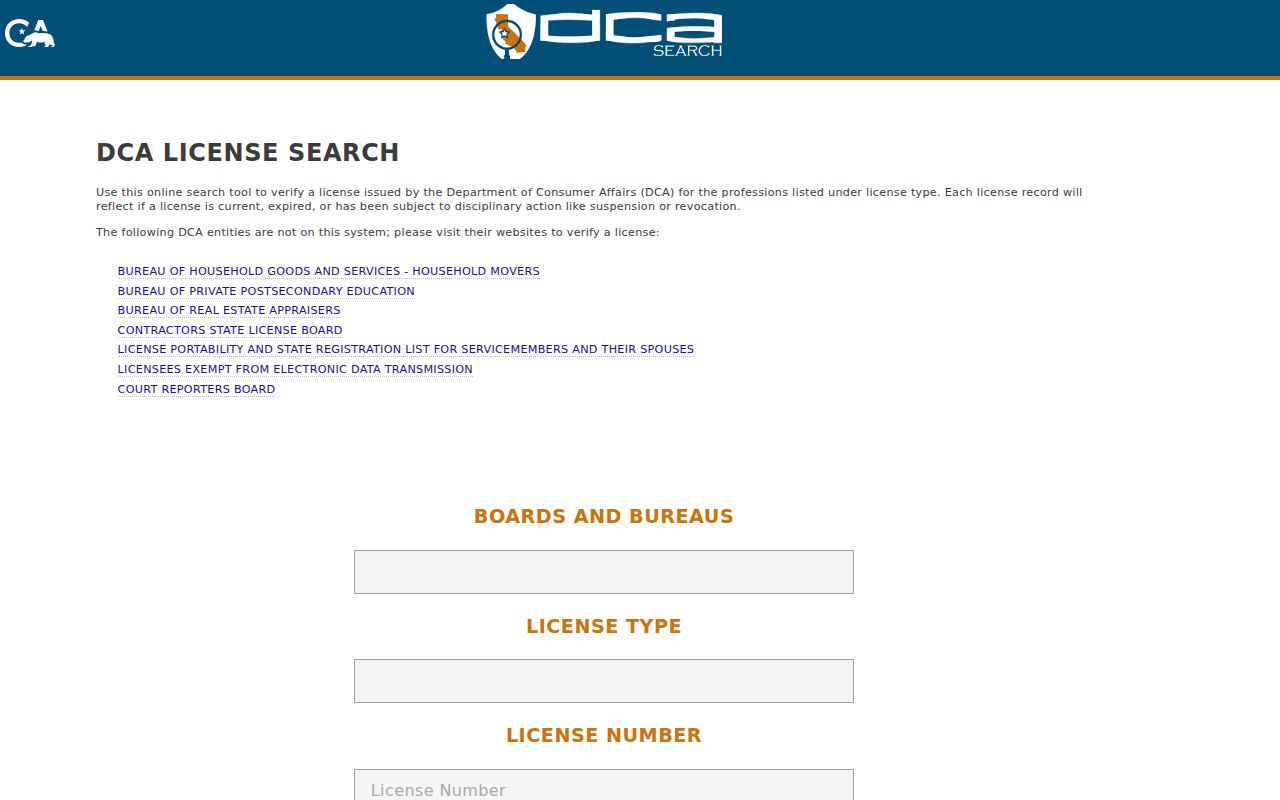
Separating license status from residence keeps a public directory result precise and avoids turning a work contact into a household claim.
Lawndale Names Need More Than One Match
Lawndale’s compact 1.97 square miles make parcel browsing practical, but density also makes same-name and unit-level errors easy. Census QuickFacts reports 31,807 residents in 2020, 9,738 households in the 2020-2024 estimate, and 37.0 percent owner occupancy. A property roll cannot stand in for the people who live in its units. Pair an AIN or address with a date, middle initial, spouse, business, court location, or other independent clue.
Language can be part of accuracy. Census QuickFacts estimates say 67.8 percent of residents speak a language other than English at home and 65.1 percent identify as Hispanic or Latino. Preserve compound surnames, spacing, hyphens, and accents. California’s recent vital-record diacritic guidance improves official spelling, but older indexes may omit marks. Search both forms as variants while retaining the spelling on the source document.
For consumer safety, California’s free Unclaimed Property search can add a city or ZIP clue after a last or business name or property ID. It is a lead, not proof of residence. Review the claim requirements with the official custodian before acting.
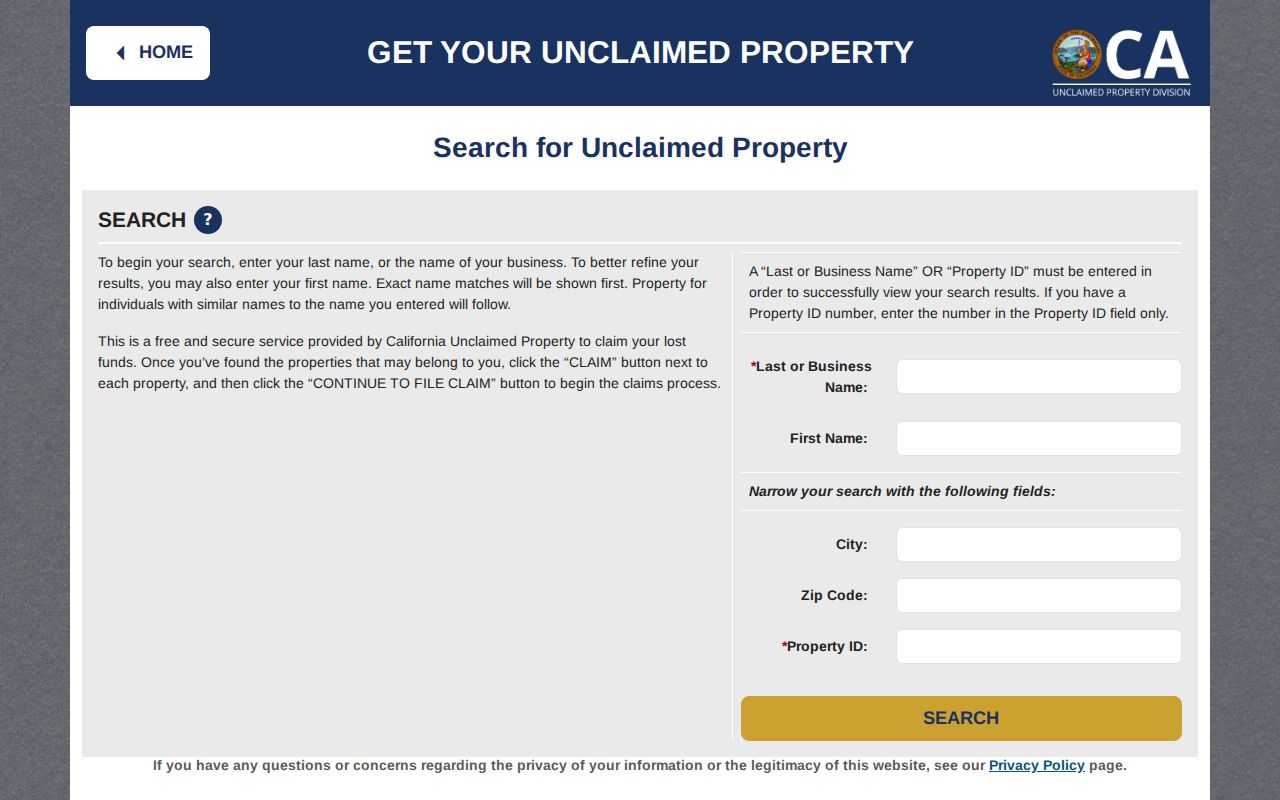
The search result can point to a claim route. Confirm the claimant and record with California’s custodian, and never pay an unknown finder before using the official process.
Lawful personal use. Lawndale records support family history, civic research, reconnecting, estate questions, and personal safety awareness. Do not use a name, address, court result, or public roll to stalk, harass, threaten, or harm anyone.